
Mon - Fri: 09.00 - 17.00
086 076 1449
info@corribviewsafety.ie

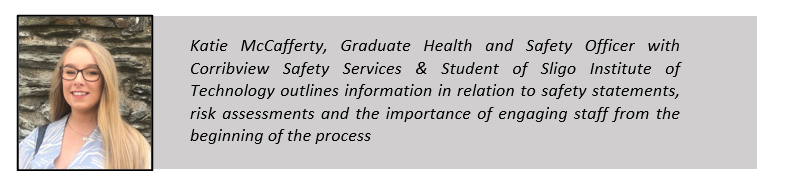
A safety statement is a written document stating the actions a company aims to fulfil to safeguard the health and safety of employees while they are at work and the health & safety of all people who might be at the workplace including customers, visitors and members of the public. A health and safety statement is a legal requirement under the Safety, Health and Welfare at Work Act, 2005.
The safety statement is the backbone to a company’s health and safety system. It identifies policies and procedures a company are required to have in place to protect their employees, including the safety policy, names and job titles of persons assigned to preform tasks pursuant of the safety statement, duties of management/employees/contractors/visitors, an outline of all the company’s safety procedures, resources required to fulfil the management of health and safety – (financial/) training/equipment etc, and risk assessments highlighting the hazards and risks present throughout the company.
A safety statement will be different from company to company in particular the risk assessments. Therefore, it is essential every safety statement is specifically tailored to each company. For example, a risk assessment conducted on the same task in two separate workplaces can establish different hazards and risks as well as, different risk ratings. This can be a result of many different factors including, employee competencies, work environments, training, individual factors, resources, equipment etc.
A company’s main priority should be to ensure their employee’s health and safety is protected while at work. At the core of this is the safety statement. It is vital employees are aware and understand the safety statement for it to be effective. For this to happen the correct behaviour towards health and safety should be a focus. If employees are not encouraged to understand and put into practice the steps outlined in the statement, why would they? The key to a successful safety culture in a company is changing the behaviour of both management and employees.
Engagement and behaviour towards health and safety in the workplace.
Establishing a strong health and safety conscious work environment is a big challenge for most companies. One tactic that works in developing a successful long term safety culture is active employee engagement. The safety statement being the main safety document in a company, it is paramount a company strives to get employees engaged in its development and understanding what it is all about. One way to get employees engaged is to include them in the decision making. They then feel a part of it and in return will be more motivated to understand the contents and put it into practice. Improving safety performance through behaviour, can lead to massive improvements within a company.
Individual employees that have a “Safety is everyone’s responsibility” outlook towards work tasks have the correct behaviour. In the long run these individuals will show more effort and care about the safety procedures in place and the safety of others in their workplace. These employees will go out of their way to ensure tasks are carried out in the correct way ensuring safety measures are followed. Engaging with employees on safety topics and including them in the writing of the procedures and conducting the risk assessments it will build trust. Resulting in the employees having a chance to voice their opinions on safety matters and provide valuable suggestions on what is needed to improve aspects of their work.
Unfortunately, not all employees will possess this behaviour, so it is up to management to try and encourage change. Often employees can become dis-engaged towards health and safety topics as a result of feeling underappreciated and feeling their suggestions are not being recognized. This can have a damaging effect on the long-term progress of a company’s safety culture.
Changing the safety culture of an organisation can be difficult and is not a simple task. However, there are a few simple steps that can be introduced to improve the attitudes and behaviours of employees towards the safety statement, that will result in a positive change.
Improving employee engagement towards health and safety.
To best improve a company’s safety culture is to start at the top and show an example through leadership. When management show employees they are committed, employees will be encouraged to follow. This can be done by management taking part in safety meetings, involved in safety walkthroughs, taking part in safety observations and talking to their employees about safety. A lack of safety leadership in a company can have a damaging effect on the safety culture of a company.
This gives employees the chance to have a voice to make suggestions they feel will make a difference. This will make health and safety more relevant and encourage them to get involved and change their behaviours around health and safety. A safety committee can also act as a string link of communication and trust between management and workers.
It is always important to recognize the efforts of employees. Positive reinforcement is an extremely powerful, evidence-based tool that enhances productivity and morale in the workplace. When good behaviour is rewarded, it is very likely the employee will keep up the good work while encouraging other employees to do the same. Rewards can be formal, informal or on-the-spot gestures that can help show the company’s appreciation for the employee going above and beyond their work responsibilities.
References
Strategies to promote safe behaviour as part of a health and safety management system. [online] Available at: <https://www.hse.gov.uk/research/crr_htm/crr02430.htm> [Accessed 1 July 2021].
Behaviour Based Safety Guide – Health and Safety Authority. [online] Available at: <http://www.hsa.ie/eng/Publications_and_Forms/Publications/Safety_and_Health_Management/behaviour_based_safety_guide.html> [Accessed 1 July 2021].
Health and Safety Statement | Peninsula Ireland. [online] Available at: <https://www.peninsulagrouplimited.com/ie/guides/health-and-safety-policy-advice/safetystatement/> [Accessed 1 July 2021].
Keep up-to-date with all of the latest news from us and from the industry.












Slieveroe,
Headford,
Co. Galway,
Ireland.
H91 DH5N
T: 086 076 1449
E: info@corribviewsafety.ie
The following links serve as very useful resources with regards to all the latest C-19 Health & Safety information.
www.gove.ie
www.hse.ie
www.hiqa.ie